OLED NEXUS / PHASE 2A.3 / SCIENTIFIC MANUSCRIPT
Abstract
Thermally activated delayed fluorescence (TADF) can return triplet-associated excitation to an emissive singlet manifold through reverse intersystem crossing (RISC). This mechanism-focused guide explains why a small singlet–triplet energy gap is neither a measurement of RISC nor a guarantee of high photoluminescence quantum yield, low efficiency roll-off, or long OLED lifetime. We connect electronic-state character, spin–orbit and vibronic coupling, molecular geometry, host environment, branching kinetics, and experimental identifiability. The coupled S/T equations use an explicit encounter-rate convention for triplet–triplet annihilation; a repeated ISC/RISC calculation separates conversion probability from photon yield. The 2018 Noda–Nakanotani–Adachi comparison preserves the original thin-film component labels and distinguishes OLED EQE from constant-current lifetime data. MR-TADF molecules are separated from TADF-sensitized hyperfluorescence device architectures. All performance claims are bounded to their stated samples, models, and operating conditions.
Learning objectives
Separate initial spin statistics, state conversion, emission branching and photon extraction.
Explain why RISC depends on state character, spin–orbit and vibronic coupling, geometry and environment—not ΔE_ST alone.
Apply an explicitly bounded rate model without confusing fitted parameters, lifetimes or photoluminescence yields.
Use complementary optical and electrically driven experiments to test competing mechanisms.
Interpret material, doped-film and complete-OLED measurements without overextending causal claims.
1. TADF in the OLED light-generation pathway
Prompt fluorescence is the early-time component of emission from a singlet excited state; “prompt” is a kinetic designation, not proof that triplets are absent elsewhere in a device. In TADF, a delayed component of singlet-state fluorescence is fed through triplet-associated population and RISC. Delayed emission does not by itself distinguish TADF from phosphorescence, triplet–triplet-annihilation-assisted fluorescence, traps, or combinations of mechanisms [1,2].
The idealized 1:3 singlet/triplet counting follows from four equally weighted spin configurations of two unpolarized spin-½ carriers. Neither the resulting 25%/75% initial model nor the emitted-light fraction is a universal property of electrical recombination. Charge capture, direct guest recombination, energy transfer, losses and later spin conversion must be distinguished [2]. Uoyama et al. reported EQE above 19% in a particular TADF OLED [1]; this is device evidence, not a general efficiency guarantee.
2. What the singlet–triplet gap does and does not tell us
Reducing donor–acceptor (D–A) frontier-orbital overlap can lower exchange splitting between charge-transfer (CT) singlet and triplet states. The same design change can reduce oscillator strength or increase sensitivity to geometry. Consequently, ΔEST, the radiative singlet rate, and the RISC pathway must be optimized together rather than independently [2].
Reported ΔEST values are method- and environment-dependent: a spectral onset in a host is not interchangeable with a vertical computational gap, an adiabatic energy difference, or an Arrhenius activation parameter. When comparing materials, identify the state assignments, medium, temperature, method and uncertainty. Multi-state mechanisms can yield apparent activation energies that do not equal a static S₁–T₁ separation [2–6].
3. Spin–orbit, vibronic and multistate pathways in RISC
Direct first-order spin–orbit coupling (SOC) between idealized ¹CT and ³CT states of nearly identical orbital character can be weak. In studied donor–acceptor systems, a locally excited triplet (³LE) may participate in second-order spin–vibronic mixing between triplet configurations and the emissive ¹CT manifold. Experimental resonance and photoinduced-absorption evidence supports such mediated channels for selected molecules, not a universal ³LE intermediate in every TADF emitter [3,4].
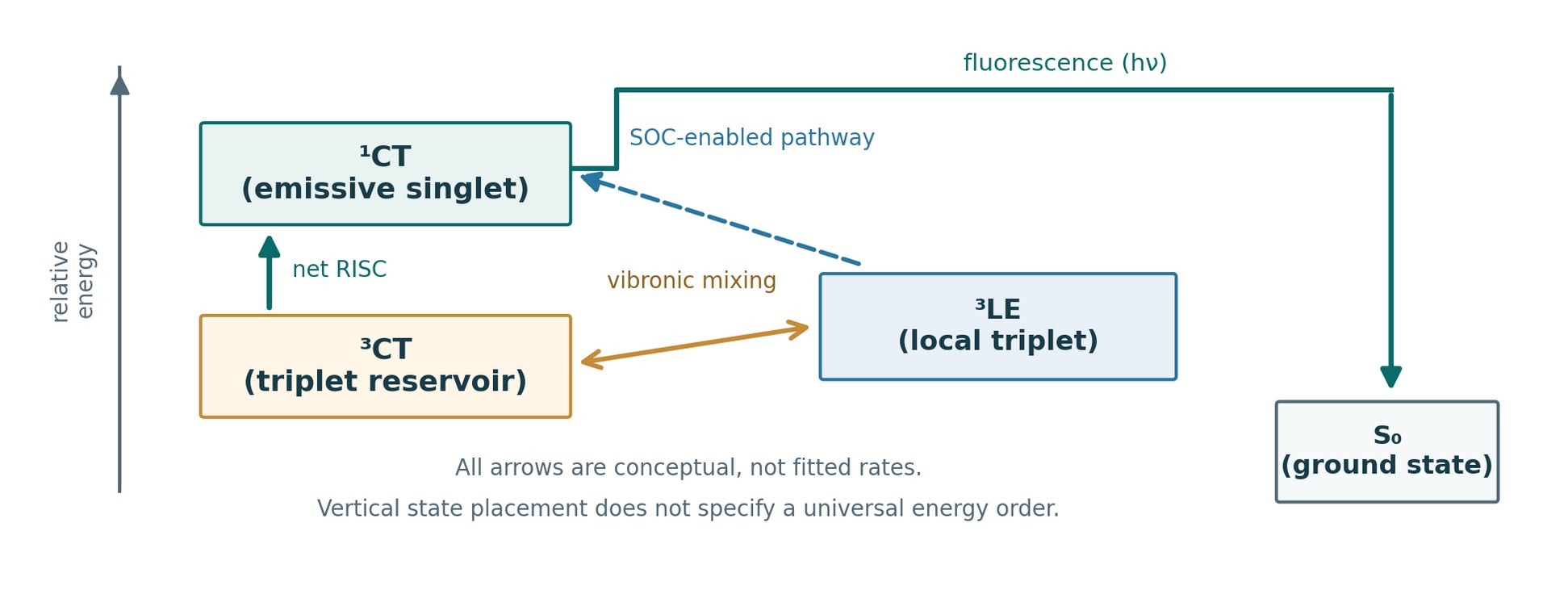
A coarse Golden-Rule argument gives kRISC ∝ |Heff|² × FCWD, where FCWD represents the relevant thermally and vibrationally weighted nuclear-state overlap. This is schematic: Heff, state mixing, transition energies and the host dielectric response are interdependent. It is incorrect to infer a unique mechanism from ΔEST or a single thermally activated slope [2–5].
An improved mechanism claim should identify states independently, assess conformer/host dependence, and predict temperature- and excitation-dependent optical signals without freely readjusting every other rate. Noda et al. used a second donor type to alter triplet-state mixing within their specific molecular series [5].
4. Molecular design: improve the entire rate network
Practical TADF optimization must retain useful singlet radiative decay while enabling triplet recovery, controlling nonradiative relaxation, and preserving electrochemical and morphological robustness. D–A twisting may lower exchange splitting but also diminish emission strength; greater rigidity may reduce some losses while altering motions involved in state mixing. Host polarity, triplet confinement, guest concentration, and carrier trapping can change which states are populated [2,5,6].
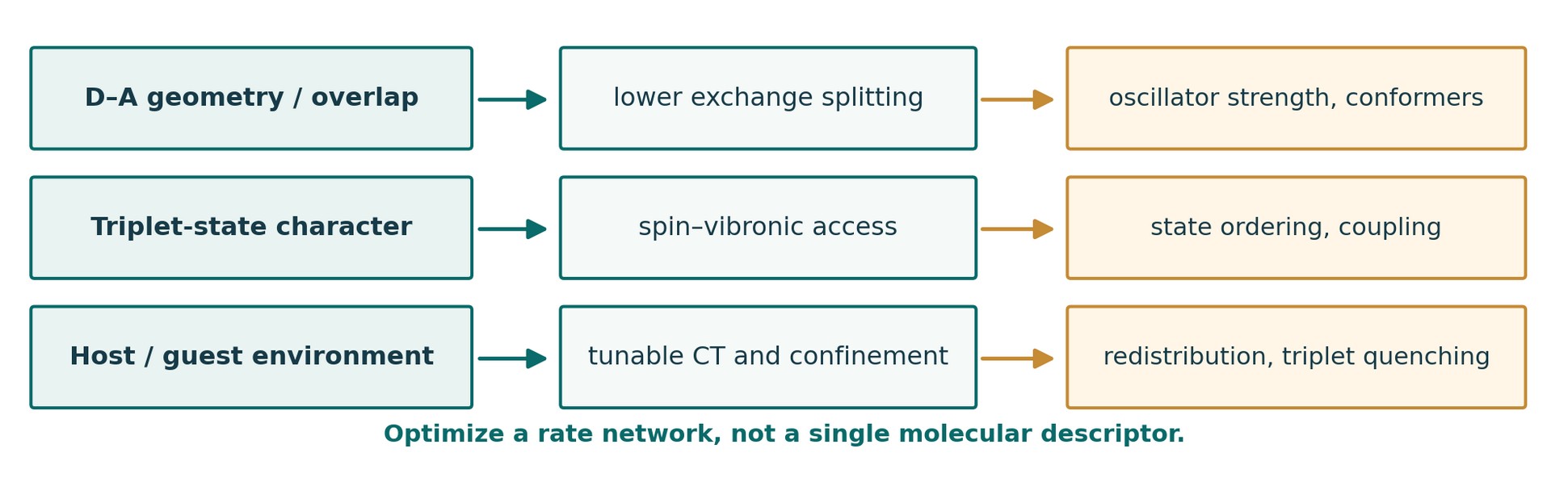
Table 1. Molecular-design variables and falsifiable checks.
| Design variable | Intended effect | Failure mode / needed measurement |
|---|---|---|
| D–A torsion/overlap | Reduce exchange splitting; tune CT | Measure oscillator strength, k_r and conformer distribution |
| ³LE vs ³CT/¹CT | Enable mediated spin–vibronic conversion | Independently identify states, ordering and coupling |
| Rigidity/local motion | Suppress some nonradiative losses | Check whether useful vibronic mixing is also restricted |
| Host polarity/triplet energy | Tune CT/LE energies; localize excitons | Compare same guest in matched hosts; back transfer |
| Emitter loading | Tune transport and transfer pathways | Aggregation, concentration quenching, charge capture |
For each design claim, report the material and host, concentration, oxygen environment, excitation mode and model used to infer its rates. A faster RISC fit in one host is not automatically transferable to a different OLED stack.
5. Why a short delayed lifetime is not a direct RISC measurement
An observed delayed decay constant is an eigenmode of a coupled rate network, rather than in general 1/kRISC. Prompt singlet decay, repeated ISC/RISC, irreversible triplet loss, trapping, density-dependent quenching, and multiple triplet manifolds all influence the delayed tail. Report delayed fractions, fitted assumptions and confidence ranges along with lifetimes [2,4,5].
For TMCz-BO, Kim et al. report τ_d = 0.75 μs and an inferred kRISC = 1.9 × 10⁶ s⁻¹ in a 30 wt% PPF film, alongside EQEmax = 20.7% for the corresponding deep-blue OLED [7]. These are different observations and inference levels; τ_d is not the reciprocal of a directly observed microscopic RISC event. Additional proposed pathways in some materials include intermolecular CT and spontaneous exciton dissociation [8].
6. Minimal coupled kinetics and explicit model boundaries
For a homogeneous effective volume, let S and T be emitter-associated singlet and triplet number densities (cm⁻³), p the relevant polaron number density (cm⁻³), and G_S and G_T effective generation rates (cm⁻³ s⁻¹). All first-order coefficients have units s⁻¹. The model is phenomenological and does not resolve distinct ³CT/³LE reservoirs, spatial diffusion, singlet–triplet annihilation, direct guest capture or host–guest transfer.
Equation 1. Singlet pool: RISC and the effective emissive-singlet branch of TTA are gains. Radiative, nonradiative and ISC processes are losses.
Equation 2. Triplet pool: the encounter-event definition means two triplets are removed per TTA event; TPQ is an effective bimolecular loss term.
Dimensional check. Every term in each equation is in cm⁻³ s⁻¹. In the chosen convention, the rate of TTA encounters is kTTAT² (cm⁻³ s⁻¹), whereas the associated triplet depletion is 2kTTAT². The factor f_S, constrained between 0 and 1, is the effective fraction of events giving one excitation in the selected S pool; it is not the TTA delayed-fluorescence quantum yield. Different publications may absorb the factor 2 into a differently named kTTA; numerical coefficients cannot be compared before conventions are harmonized.
The loss term kother,T denotes a separately defined first-order removal from the chosen T pool. It is zero if an identical pathway is already included in knr,T. Such removal need not equal device-wide energy loss if excitation is transferred into another pool not explicitly modeled. kTPQ depends on the chosen spatially averaged density conventions; an apparent fitted coefficient is not automatically a universal microscopic encounter constant.
Table 2. Rate-model definitions and limitations.
| Symbol | Units / defined role | Interpretation |
|---|---|---|
| S, T, p | cm⁻³ | Effective densities in a stated active volume |
| G_S, G_T | cm⁻³ s⁻¹ | Formation/source terms; PL ≠ EL initial condition |
| k_RISC, k_ISC | s⁻¹ | Effective fitted spin-interconversion rates |
| k_r,S; k_nr,S; k_nr,T; k_other,T | s⁻¹ | Nonoverlapping one-body pathways |
| k_TTA; k_TPQ | cm³ s⁻¹ | Encounter-event coefficients in this convention |
| f_S | dimensionless | One selected singlet per TTA encounter fraction; not photon yield |
6.1 A solvable branching example: repeated ISC/RISC
Under constant first-order rates with no TTA, TPQ, traps or other coupled reservoirs, define a = kRISC/(kRISC+knr,T+kother,T) as the probability that an initially populated T reaches S before irreversible T-pool loss. Within S, define b = kr,S/(kr,S+knr,S+kISC) and c = kISC/(kr,S+knr,S+kISC). Each S→T return offers another RISC attempt.
Equation 3. Eventual internal-photon probability per initial T excitation for this one-excitation, time-independent, constant-rate model (0 ≤ ac < 1).
This sum is not the RISC single-pass probability a, not EQE, and not a universal internal OLED quantum efficiency. An explicit electrical-generation model, radiative coupling to other states and outcoupling are needed before predicting external photons. The product ab/(1−ac) follows from conditional branching, not statistical independence of real material parameters.
7. Mechanism evidence must discriminate alternatives
Oxygen sensitivity, delayed PL, thermally activated emission, or a biexponential fit are individually insufficient to identify TADF. Delayed fluorescence can coexist with TTA-assisted emission or trap-related processes; varying temperature, fluence, host and atmosphere can change their relative contributions. Use several independent observables and compare competing kinetic models with uncertainty and parameter-identifiability analysis [2,4,8].
Table 3. Measurement-to-mechanism evidence matrix.
| Measurement/control | Can support | Cannot prove alone |
|---|---|---|
| Time-resolved prompt/delayed PL | Temporal populations in a defined sample | RISC uniquely causes all delayed emission |
| Same-film temperature series | Activation, model discrimination | Apparent activation = static ΔE_ST |
| Excitation-fluence series | Bimolecular signatures and saturation | Unique separation of TTA/traps/RISC |
| Transient absorption | Triplet / CT / LE state populations | OLED EQE and lifetime |
| Oxygen/host/loading controls | Environmental and triplet involvement | The same EL mechanism under injection |
| Transient EL plus J–V–L | Electrical recombination/exciton dynamics | A unique microscopic k_RISC without transport modeling |
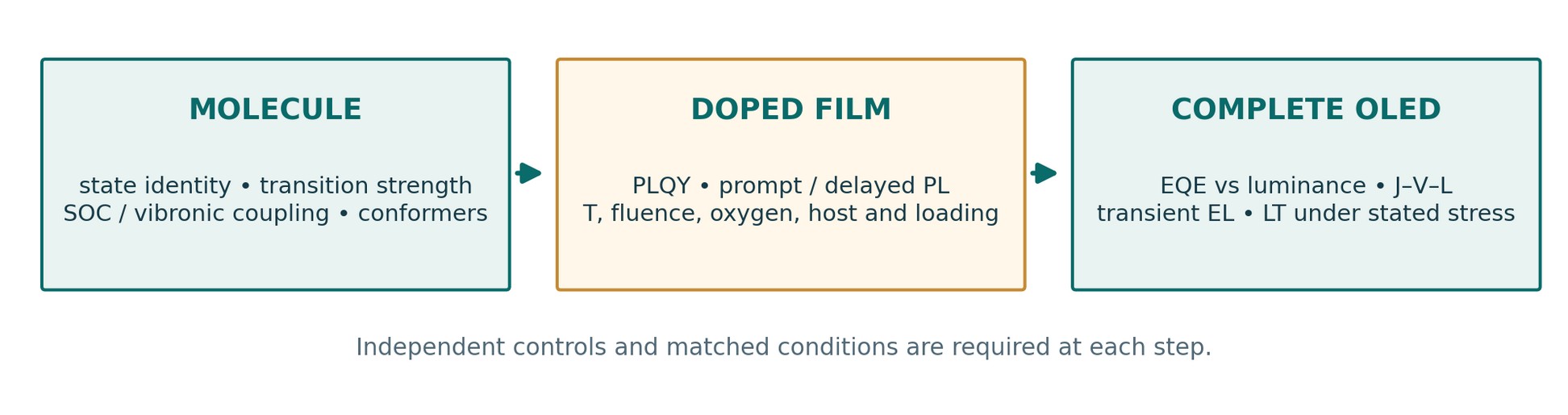
A reproducible analysis should specify data series fitted jointly, fixed versus free parameters, photophysical preparation (optical versus electrical), sample-to-sample variation, and the alternative models rejected. When one decay fits many parameter sets, report a bound or non-identifiability rather than a falsely precise kRISC.
8. EQE accounting, operating conditions and non-independence
With explicitly chosen accounting boundaries, one conceptual representation is EQE = γ × Φint,eff × ηout. Here γ is the fraction of injected electron–hole pairs yielding an excitation in the selected starting population; Φint,eff is the eventual probability that one such excitation produces an internal photon, allowing RISC and all subsequent pathways exactly once; ηout is the proportion of those photons escaping into a stated external angular/spectral collection convention. It is a conditional-event factorization, not a claim that these physical processes or measured parameters are statistically independent [2].
Boundary example. Direct recombination on the guest contributes to γ under a convention starting from useful guest excitation. If the chosen start is instead all host/guest excitations, host→guest transfer belongs inside Φint,eff; similarly, sensitizer ISC/RISC and sensitizer→terminal-emitter transfer must be included within the chosen internal-photon pathway, not multiplied a second time as an independent “triplet harvesting efficiency.” These conventions must be declared before cross-paper comparison.
Electrically driven EQE further depends on carrier balance, recombination-zone width, host confinement, transfer losses, optical mode distribution, emitter orientation and current-density-dependent quenching. Report EQEmax separately from EQE at stated luminance; report CIE, FWHM, voltage and measurement conditions wherever available. LT97 under constant current at one initial brightness cannot be treated as equivalent to LT95/LT50, an accelerated lifetime extrapolation or a constant-luminance stress test [5,9].
9. Primary-study teaching case: 5CzBN versus 3Cz2DPhCzBN
Noda, Nakanotani and Adachi (2018) studied changes in locally excited triplet mixing, model-derived RISC rates and OLED outcomes when a second donor type was introduced [5]. The comparison is unusually useful because the 20 wt% mCBP-doped films are paired with fabricated OLEDs, selected carrier-transport control devices and operational-stability traces. However, several parameters besides RISC change, including radiative and ISC rates, emission color, and transport; the study does not isolate RISC as the unique cause of improved lifetime.
Table 4. Primary Table 2: 20 wt% emitters in mCBP; the authors’ reporting convention retained.
| Thin-film quantity | 5CzBN | 3Cz2DPhCzBN | Evidence |
|---|---|---|---|
| PL peak (nm) | 486 | 495 | Measured thin-film spectrum |
| Prompt/delayed PLQY components (%) | 16 / 65 | 14 / 80 | Original table labels; ±2% |
| Prompt lifetime τ_p (ns) | 3.2 | 4.5 | Measured PL transient |
| Delayed lifetime τ_d (μs) | 10.2 | 5.65 | Measured PL transient |
| k_r (s⁻¹) | 5.0 × 10⁷ | 3.0 × 10⁷ | Model-derived |
| k_ISC (s⁻¹) | 2.6 × 10⁸ | 1.9 × 10⁸ | Model-derived |
| k_RISC (s⁻¹) | 3.6 × 10⁵ | 9.9 × 10⁵ | Model-derived |
| k_nr,T (s⁻¹) | 4.1 × 10⁴ | 4.1 × 10⁴ | Model-derived |
Important original-source wording boundary: Noda et al. label “16/65” and “14/80” as prompt/delayed PLQY in Table 2, while nearby prose describes 65 ± 2% and 80 ± 2% as film PLQYs. We reproduce the paired table entries exactly and do not silently sum, reinterpret or relabel them as an independently verified total. Quantitative modeling should check the authors’ original extraction convention and underlying methods before reusing them as a generic Φ_p + Φ_d decomposition.
Table 5. Device Table 3 plus original Figure 3 caption: matched luminance is not matched current.
| Complete-OLED property | 5CzBN | 3Cz2DPhCzBN | Condition |
|---|---|---|---|
| EQE at 500 cd m⁻² | 18.0% | 20.9% | Measured at stated luminance |
| EQE at 1000 cd m⁻² | 17.0% | 20.8% | Measured at stated luminance |
| EQE at 5000 cd m⁻² | 13.9% | 18.6% | Measured at stated luminance |
| Voltage at 500/1000/5000 cd m⁻² | 5.0/5.6/7.7 V | 5.2/5.8/7.4 V | Measured in primary Table 3 |
| CIE (x,y) | (0.19, 0.41) | (0.21, 0.44) | EL chromaticity |
| LT97 (h) | 3 | 110 | Representative constant-current tests |
| Lifetime-test current density (mA cm⁻²) | 2.4 | 1.6 | Both at initial L₀ = 1000 cd m⁻² |
The primary paper reports EQE variability of ±0.2% across at least four devices; its stated LT97 values come from representative constant-current traces, not a formal lifetime distribution. The inferred RISC rate is ≈2.75-fold higher for 3Cz2DPhCzBN. Nevertheless, the 110/3 lifetime contrast cannot be assigned to RISC alone: electron-only controls suggest altered electron transport and a wider recombination zone, and substituent effects may matter [5]. This is mechanistically plausible evidence, not a one-parameter causal decomposition.
Remaining source boundary: Original main-text Tables 2–3 and Figure 3 caption have been checked against the open primary article. Supplementary Figure S5 and the full device layer stack/thicknesses have not been independently inspected here; they are deliberately not reconstructed. A public version should finish the supplementary-device audit before asserting a complete layer-by-layer comparison.
10. MR-TADF molecules versus sensitized hyperfluorescence devices
Conventional strongly CT-like D–A TADF can broaden emission through excited-state relaxation and conformational/host disorder. Multiple-resonance TADF instead exploits atomically patterned orbital distributions to realize narrow spectral emission in selected molecules, though narrow FWHM is not a surrogate for fast RISC, operational stability or device lifetime [10]. Hatakeyama et al. reported a 467 nm emission peak and 28 nm FWHM in a specified early MR-TADF OLED [10].
Table 6. Classification and provenance boundaries.
| Category | What is classified | Caution |
|---|---|---|
| Conventional D–A TADF | Emitter molecule/CT-oriented design | Gap, oscillator strength and RISC can compete |
| MR-TADF | Emitter molecule/orbital-resonance design | Narrow FWHM does not imply high stability |
| TADF-sensitized fluorescence | Device architecture with terminal fluorophore | Sensitizer RISC ≠ terminal emitter RISC |
| MR-terminal hyperfluorescence | Device architecture using narrowband terminal emitter | Measure transfer losses, trapping and Dexter pathways |
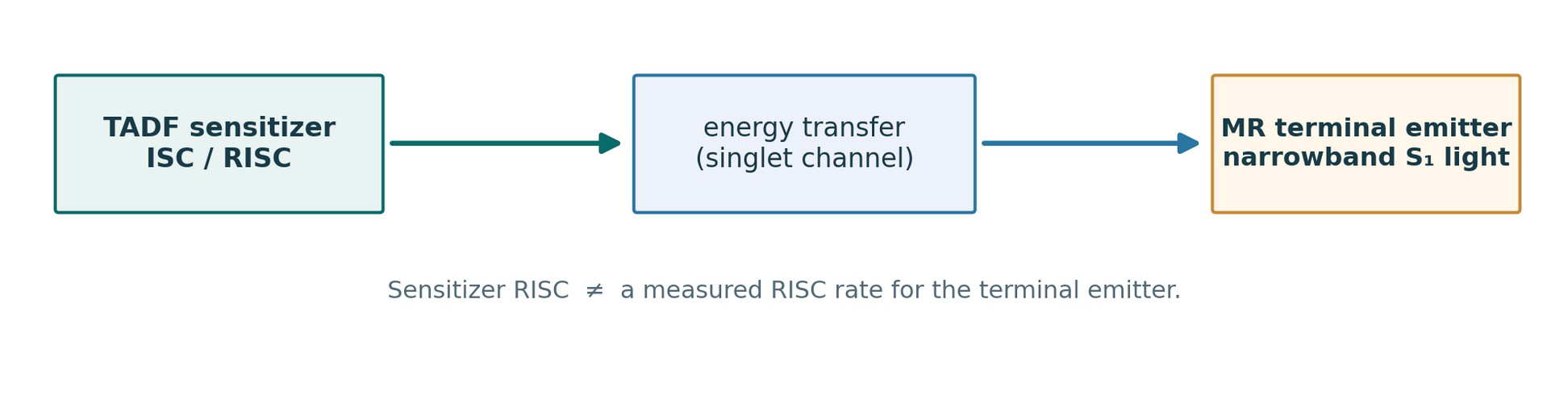
Huang et al. (2024) report a deep-blue device with a TADF sensitizer and multiple-resonance terminal emitter reaching EQEmax = 30.8%, LT95 = 221 h at initial L₀ = 1000 cd m⁻², and CIE (0.14, 0.17) [12]. These are complete sensitized-device outcomes, not intrinsic performance metrics of the standalone TADF sensitizer. Their broader material design analysis also considers negative-polaron/triplet stability and radiative dynamics [12]; a faster RISC rate alone cannot be credited with every improvement. Hyperfluorescence energy transfer, charge trapping and terminal-emitter emission require separate evidence [11,12].
11. Open questions with falsifiable tests
Microscopic pathway: can CT/LE state assignments and independently supported SOC/vibronic couplings predict host- and temperature-dependent spectroscopy without refitting every rate?
Parameter identifiability: do same-sample fluence-dependent PL, triplet absorption and absolute PLQY place useful confidence bounds on k_RISC against alternate TTA/trap models?
Device attribution: after controlling charge balance, optical outcoupling and recombination-zone width, how much roll-off variation is associated with RISC?
Operational stability: can reversible quenching be separated experimentally from irreversible chemical degradation under comparable current and luminance stress?
Predictive screening: do environment-aware gaps, transition dipoles, CT/LE character, coupling descriptors and chemical robustness predict out-of-sample OLED measurements better than gap-only ranking?
A transferable mechanism claim should document substrate/host preparation, atmosphere, temperature, excitation protocol, time/fluence ranges, device geometry, error bars and model assumptions. Calculated gas-phase ΔEST alone is inadequate support for a predicted device lifetime or EQE.
12. Conclusions and publication boundaries
TADF performance emerges from coupled spin conversion, singlet emission, triplet loss, electronic transport and optical extraction. The reviewed evidence supports multistate spin–vibronic pathways in specific materials, while showing that neither the smallest gap nor the largest fitted k_RISC is a universal device-performance predictor. The Noda comparison illustrates how faster inferred RISC can coincide with lower efficiency roll-off and much longer LT97, yet changes in transport, drive current and substitution prevent a unique causal interpretation. The appropriate research standard is a falsifiable mechanism tested across molecule, film and OLED—not a ranking based on one number.
Source-verification boundary. The scientific owner authorized public publication on 27 October 2026. That authorization does not certify external peer review or closure of all original-source checks. Noda et al. Supplementary Figure S5 has not yet been independently inspected for all device-layer details; references with only abstract-level access are identified in the audit. Claims requiring unverified device parameters have been excluded rather than estimated.
Source verification and interpretation limits
The reference-by-reference internal source-to-claim audit is retained in the project editorial records. Some cited original works were reviewed at abstract or metadata level; the Noda 2018 main article, Tables 2–3 and Figure 3 context were inspected, but its Supplementary Figure S5 and complete layer-thickness details are not claimed to be verified. Experimental results are reported for specific films, devices and conditions; fitted parameters are not universal constants.
Where performance metrics appear, measurements on doped films are distinguished from complete-OLED outcomes. The example is not a causal proof that RISC alone determines device efficiency or operational lifetime.
References
- Uoyama, H., Goushi, K., Shizu, K., Nomura, H. & Adachi, C. Highly efficient organic light-emitting diodes from delayed fluorescence. Nature 492, 234–238 (2012). https://doi.org/10.1038/nature11687
- Eng, J. & Penfold, T. J. Open questions on the photophysics of thermally activated delayed fluorescence. Communications Chemistry 4, 91 (2021). https://doi.org/10.1038/s42004-021-00533-y
- Gibson, J., Monkman, A. P. & Penfold, T. J. The importance of vibronic coupling for efficient reverse intersystem crossing in thermally activated delayed fluorescence molecules. ChemPhysChem 17, 2956–2961 (2016). https://doi.org/10.1002/cphc.201600662
- Etherington, M. K. et al. Revealing the spin–vibronic coupling mechanism of thermally activated delayed fluorescence. Nature Communications 7, 13680 (2016). https://doi.org/10.1038/ncomms13680
- Noda, H., Nakanotani, H. & Adachi, C. Excited state engineering for efficient reverse intersystem crossing. Science Advances 4, eaao6910 (2018). https://doi.org/10.1126/sciadv.aao6910
- Gillett, A. J. et al. Dielectric control of reverse intersystem crossing in thermally activated delayed fluorescence emitters. Nature Materials 21, 1150–1157 (2022). https://doi.org/10.1038/s41563-022-01321-2
- Kim, J. U. et al. Nanosecond-time-scale delayed fluorescence molecule for deep-blue OLEDs with small efficiency rolloff. Nature Communications 11, 1765 (2020). https://doi.org/10.1038/s41467-020-15558-5
- Gillett, A. J. et al. Spontaneous exciton dissociation enables spin state interconversion in delayed fluorescence organic semiconductors. Nature Communications 12, 6640 (2021). https://doi.org/10.1038/s41467-021-26689-8
- Hasan, M. et al. Probing polaron-induced exciton quenching in TADF based organic light-emitting diodes. Nature Communications 13, 254 (2022). https://doi.org/10.1038/s41467-021-27739-x
- Hatakeyama, T. et al. Ultrapure blue thermally activated delayed fluorescence molecules: Efficient HOMO–LUMO separation by the multiple resonance effect. Advanced Materials 28, 2777–2781 (2016). https://doi.org/10.1002/adma.201505491
- Deori, U., Nanda, G. P., Murawski, C. & Rajamalli, P. A perspective on next-generation hyperfluorescent organic light-emitting diodes. Chemical Science 15, 17739–17759 (2024). https://doi.org/10.1039/D4SC05489J
- Huang, T. et al. Delocalizing electron distribution in thermally activated delayed fluorophors for high-efficiency and long-lifetime blue electroluminescence. Nature Materials 23, 1523–1530 (2024). https://doi.org/10.1038/s41563-024-02004-w