Technology / OLED fundamentals / Guide 02
Fluorescence and Phosphorescence in OLEDs
Spin Selection, Exciton Harvesting, and Device Implications
A mechanism-to-measurement guide distinguishing radiative channels, spin statistics, excitation transfer, triplet loss, and externally measured device performance.
PUBLICATION AUTHORIZED · Owner scientific review accepted
Abstract
A photon emitted from an OLED does not uniquely reveal where its precursor exciton was formed or which spin and energy-transfer processes preceded emission. This guide distinguishes radiative selection rules from exciton-formation statistics, and both from current-dependent device efficiency. It develops a minimal coupled singlet–triplet–acceptor kinetic model with explicit units and competing channels; delineates the accounting boundaries in EQE; and outlines discriminating tests for phosphorescence, thermally activated delayed fluorescence (TADF), triplet–triplet-annihilation-assisted fluorescence and quenching. A primary-study case links mCP:4CzIPN device composition, time-resolved photophysics and current-dependent loss analysis, while specifying parameters that are not available from the checked source. The guide is an explanatory synthesis, not a report of new experiments. [1] [2] [3]
Part I — Spin selection and the origin of emission
1. Which molecule emits, and where did its excitation come from?
Prompt fluorescence is the prompt component of singlet-state emission following excitation. Its observed kinetics depend on initial-state preparation and competing excited-state processes; the label alone does not demonstrate the absence of triplet-mediated pathways elsewhere in the device. Phosphorescence involves a spin-multiplicity-changing radiative transition, conventionally T₁→S₀, enabled by spin–orbit coupling or other state mixing. Delayed fluorescence is still a singlet-state radiative event; its delayed singlet population can be supplied by RISC, triplet–triplet annihilation (TTA), or another slower process. Observed time structure alone is not a complete mechanistic assignment. [2]
The electrical origin is an independent question. Recombination can first occur on a host, an emitter, or an interfacial charge-transfer (CT) configuration; subsequent energy transfer or state conversion may move the excitation to the molecule that emits. Electrode–organic interface energetics and carrier trapping can alter the initial branching. The final emitter’s fluorescence/phosphorescence label is not a direct measurement of these upstream pathways. [4]
2. Conditional 1:3 spin statistics versus real device populations
Two independently injected, unpolarized spin-½ carriers span one singlet and three triplet spin substates. Only when formation probabilities are equal for these configurations does the familiar statistical baseline follow: P(S)≈1/4 and P(T)≈3/4. It is a count of accessible configurations under stated assumptions, not a universal measured singlet yield, internal quantum efficiency (IQE) or external quantum efficiency (EQE). Distinct spin-dependent formation cross-sections and other device dynamics can invalidate direct translation of this counting result into populations. Wohlgenannt and colleagues investigated formation cross-sections in specific π-conjugated polymers; those observations should not be generalized to all molecular OLED stacks. A correction to that paper concerns a molecular-structure illustration and must be considered if reproducing molecular depictions; no such depiction is reproduced here. [5]
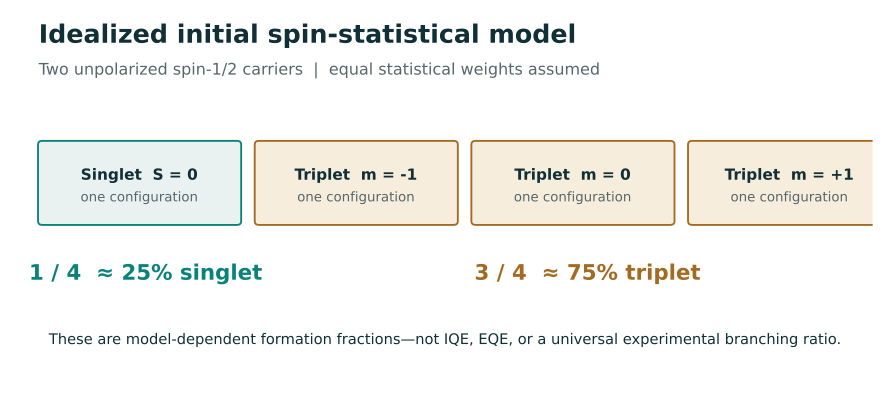
On smaller screens, scroll horizontally to view the full diagram.
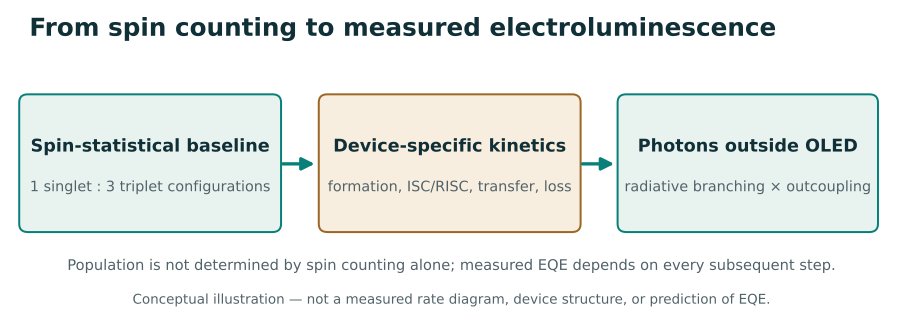
On smaller screens, scroll horizontally to view the full diagram.
Practical formation and fate should be tested separately: charge-balance/transport measurements constrain recombination, time-resolved spectroscopy constrains state-population kinetics, and calibrated optical/electrical measurements constrain the fraction of internal emission that reaches the detector. [4] [6]
3. Fluorescence, phosphorescence and radiative branching
For an isolated emissive singlet pool with first-order depopulation, its conditional fluorescence quantum yield may be written Φ_F= k_r,S/(k_r,S+k_nr,S+k_ISC+k_other). All k terms have units of s⁻¹ and refer to the same population and optical environment. The equation assumes stationary first-order competing channels from that chosen state. It excludes carrier formation, RISC repopulation, intermolecular transfer, high-density annihilation and outcoupling unless those are explicitly modeled. [2]
For many purely organic chromophores the spin-pure T₁→S₀ transition is electric-dipole forbidden to first order; spin–orbit mixing can lend intensity. Selected Ir/Pt complexes can exhibit useful triplet-character phosphorescence, but heavy-atom coupling is not proof of perfect device exciton capture or stability. Baldo et al. established an influential device-level electrophosphorescence route; their original full paper remains outside the present full-text verification boundary. [1]
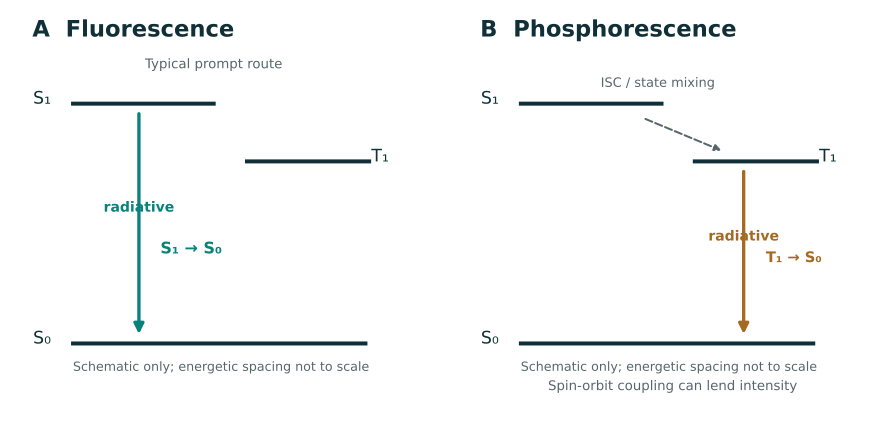
On smaller screens, scroll horizontally to view the full diagram.
Historical context (not the primary case study): Adachi et al. reported maximum EQE (19.0±1.0)% and calculated IQE (87±7)% in a device using (ppy)₂Ir(acac) doped into a wide-gap host identified as 3-phenyl-4(1′-naphthyl)-5-phenyl-1,2,4-triazole. The checked abstract does not establish the full stack, a matched brightness-point EQE, or lifetime. These values must not be transplanted to a different host or architecture. [7]
Part II — Useful excitation and competing loss
4. Host–guest interactions: transfer is not recombination
Förster transfer is a nonradiative Coulombic coupling channel generally favored between optically allowed donor and acceptor transitions, with spectral overlap, transition dipole orientation and distance affecting rate. Dexter transfer arises from short-range exchange and sufficient orbital overlap; triplet–triplet transport can be useful when a phosphorescent guest harvests triplets, or detrimental when triplets accumulate in a dark fluorescent terminal emitter. Neither mechanism is inherently beneficial or harmful: net utility is set by the destination, subsequent branching and competing rates. [8] [9]
| Process | Key physical signature | Evidence needed / nonunique alternatives |
|---|---|---|
| Förster-type energy transfer | Donor decay coupled to acceptor rise; optical transition coupling and spectral overlap | Spectral overlap plus donor-lifetime shortening and acceptor-time correlation; direct charge formation can mimic steady-state spectral changes |
| Dexter/exchange transfer | Short-range electronic overlap; often triplet-to-triplet redistribution | Composition/distance series, state-sensitive transient detection and triplet-energy mapping; avoid calling exchange a loss without the destination |
| Charge transfer / direct trapping | Carrier transfer or localization, CT-state formation, direct recombination on guest | Single-carrier controls, electrical bias dependence, CT absorption/emission or charge-sensitive spectroscopy |
| Direct guest excitation | Excitons initially form on emitting guest during electrical drive | Charge localization and carrier-balance measurements, sensitizer-free and host-only device comparisons |
A higher acceptor EL fraction or weaker donor PL alone does not prove FRET: changes in charge balance, traps, interfacial CT formation and guest recombination may lead to similar observations. Host-triplet energy above guest-triplet energy is a useful design heuristic for trapping phosphorescent excitation, not a sufficient condition for efficiency: morphology, local energetic disorder, back transfer and quenching must also be considered. [8] [9]
5. Triplet utilization: phosphorescence, TADF and TTA
In electrophosphorescence, radiative triplet-character states on a suitable guest can harvest excitation that simple prompt fluorescence would often discard. In TADF, RISC repopulates an emitting singlet manifold, after which the photon is fluorescent; a small singlet–triplet gap alone does not ensure rapid RISC. Spin–vibronic coupling, local/CT state mixing, near-resonant intermediate triplets, and competing decay can alter conversion. Etherington and colleagues tested a spin–vibronic mechanism by tuning state resonance and examining photoinduced absorption; the evidence illustrates why a single ΔE_ST cannot identify the RISC rate. [10]
TTA-assisted delayed fluorescence requires the encounter of two triplet excitations and may feed an emitting singlet if energetic and spin branching permit. TADF, TTA, and phosphorescence can coexist in one material or device; their relative contributions may change with temperature, excitation density, and electrical bias. Only some encounters yield a useful singlet; delayed output depends additionally on the singlet radiative yield. Thus TTA triplet disappearance, TTA singlet creation and delayed-photon yield are separate observables. A triplet-derived delayed emission band is not uniquely TADF, TTA or phosphorescence without complementary evidence. [2]
Modern sensitized fluorescence/hyperfluorescence can use a sensitizer’s triplets upstream and terminal fluorescent emission downstream. Sensitizer RISC, favorable Förster-type transfer, reduced Dexter transfer into dark final-emitter triplets, and minimized direct charge trapping must be treated together. Nakanotani et al. reported an important TADF-assisted route, but a device-specific quantitative reconstruction requires the original full text and supplement, not only the checked abstract. [11] [8]
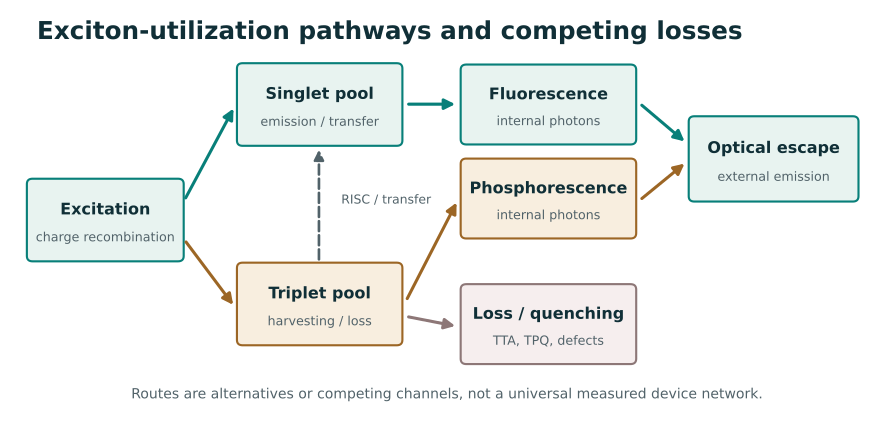
On smaller screens, scroll horizontally to view the full diagram.
6. From a pathway sketch to a minimal kinetic model
To express rate competition quantitatively, define S and T as number densities (cm⁻³) of sensitizer singlet and triplet excitations in an approximately homogeneous representative zone, A as density of fluorescent-acceptor singlets, and p as polaron density (cm⁻³). G_S and G_T (cm⁻³ s⁻¹) are effective formation terms. Every first-order k (s⁻¹) refers to departure from the state explicitly named; bimolecular coefficients have units cm³ s⁻¹. This lumped model ignores diffusion gradients and assumes effective coefficients are constant within the analyzed interval. [3]



Mathematical consistency check: every term in the three equations has units of cm⁻³ s⁻¹. The +k_RISC T and −k_RISC T pair, and +k_ISC S and −k_ISC S pair, explicitly conserve population between S and T before other losses. The −k_FRET S source loss is matched by +k_FRET S in A; this simple transfer is assumed one-to-one. The TTA event rate is k_TTA T², triplet loss is 2k_TTA T², and the specified singlet-product source is f_S k_TTA T². This is internally consistent only because f_S is a defined yield of one sensitizer singlet per encounter, not an assumed universal spin-statistical factor. If the encounter yields a different state, its source must enter another equation. The −k_Dexter T term means departure from the sensitizer triplet pool, not necessarily whole-device nonradiative loss. The −k_TPQ T p term treats the selected TPQ events as triplet losses; it does not mean all polaron-mediated channels were identified. The A pool excludes direct guest exciton creation, guest triplets, reverse transfer, and acceptor polaron quenching: this is a deliberately incomplete, non-fitted OLED model. [3] [12]
| Symbol | Meaning in this illustrative model | Units / qualification |
|---|---|---|
| S, T, A, p | Sensitizer singlets, sensitizer triplets, acceptor singlets, polarons | cm⁻³; volume densities, not normalized signal intensity |
| G_S, G_T | Source terms under chosen electrical/optical excitation | cm⁻³ s⁻¹; not fixed by spin degeneracy |
| k_r, k_nr, k_ISC, k_RISC, k_FRET, k_Dexter | Single-particle emission, nonradiative loss, spin conversion, interspecies transfer | s⁻¹; spatially and environment dependent |
| k_TTA, k_TPQ | Triplet-pair encounter events and triplet–polaron loss | cm³ s⁻¹ when S,T,p are volume densities |
| f_S | Singlet-producing branch per TTA encounter | dimensionless, 0 ≤ f_S ≤ 1; not a universal 1/4 factor |
The model predicts that a faster RISC may improve emissive access only if it competes successfully with triplet loss; stronger FRET helps only if the accepting state remains radiative and its high-density losses do not dominate. Steady-state EQE is a single output and cannot identify all kinetic constants: combinations of generation, conversion, quenching and outcoupling may generate similar curves. Transient PL, excitation-density series, carrier-only controls and measured optical constants are needed as independent constraints. [3] [10]
7. TTA and triplet–polaron quenching: units, identification and limits
For a simpler phosphorescent guest population n_T (cm⁻³), a homogeneous steady-drive illustration is dn_T/dt = G_T − k_1 n_T − 2k_TTA n_T² − k_TPQ n_T p, where G_T has units cm⁻³ s⁻¹, k_1 has s⁻¹, and k_TTA and k_TPQ have cm³ s⁻¹. This is the same triplet-removal convention adopted in Section 6, with k_TTA counting encounter *events* rather than total triplet disappearance. The factor two indicates two triplets removed per encounter under the event-rate convention; papers that absorb it into k_TTA use a different numerical coefficient. It is incorrect to equate the disappearance term directly with delayed fluorescence. Nonuniform densities turn the local nonlinear terms into spatial integrals and can invalidate a uniform-density fit. [12]
Reineke and colleagues specifically examined TTA, polaron-mediated quenching and field-induced processes in red Ir(piq)₃ and green Ir(ppy)₃ OLED architectures using time-resolved PL, unipolar control devices and an analytical efficiency model. Their publisher abstract describes both TTA and TPQ as influential in the studied devices and attributes the stronger roll-off of the particular green device partly to longer triplet lifetime and a narrower formation zone. These conclusions should not be generalized to all green versus red OLEDs. [12]
A falsifiable TPQ investigation varies current or carrier density and measures emitter lifetime/PL attenuation with complementary unipolar controls, then compares models including and excluding TPQ while constraining electron/hole distributions. Polaron-coupled exciton quenching may differ by spin species and material. The extracted k_TPQ depends on the assumed exciton–polaron overlap, injection balance and density model; A fitted number is not a uniquely proven microscopic interaction. In the Hasan primary study k_SP and k_TP correspond to singlet–polaron and triplet–polaron annihilation, respectively; its symbols and assumptions must not be confused with the generic TPQ term in our teaching model. [3]
Part III — Measurement-to-device evidence
8. EQE factor boundaries and model identifiability

| Factor | Boundary adopted in this guide | What must not be double counted |
|---|---|---|
| γ | Injected carrier pairs → chosen initially formed active excitation pool; includes imbalance and failed recombination | Do not include subsequent host–guest energy transfer again |
| η_util | Those formed excitations → specified final emitting-state ensemble; includes chosen RISC / transfer accounting once | Do not recount the same spin conversion or transfer in Φ_rad,eff |
| Φ_rad,eff | Conditional internal photon probability after arrival in that ensemble | Do not again include pathways already assigned to η_util |
| η_out | Internal photons → stated external collection domain | Do not confuse optical escape with angle/spectrum calibration conventions |
These dimensionless factors form conditional bookkeeping probabilities or effective fractions defined by a chosen sequence of physical boundaries, not statistically independent or universally measurable efficiencies. A factor may change when another factor or the device architecture changes; an EQE product does not imply experimental separability. Direct charge capture on a guest enters the initial active pool if it is included in γ; host-to-emitter transfer occurring later belongs to η_util under the convention above. Other authors may make different assignments. For example, direct guest capture/recombination forms excitations within γ and passes directly into the chosen emitting-state ensemble, so it contributes to η_util without adding a fictitious FRET step. Host recombination followed by guest-directed FRET enters γ at host exciton formation, then enters η_util upon arrival at the guest. For a TADF sensitizer followed by FRET, both RISC and FRET belong to η_util under this convention; neither is counted again in the guest-conditional Φ_rad,eff. A measured EQE cannot by itself determine γ, RISC efficiency, PLQY and outcoupling independently. The optical η_out is defined relative to a stated external collection solid angle/spectral window and corrected photon flux, not an unreported instrument collection factor. In practice report measurement geometry, polarization/dipole assumptions and any optical modelling used. [6]
9. Mechanism discrimination: measurements that can falsify a model
| Measurement / intervention | Supportive observation | Competing explanation / limit |
|---|---|---|
| Temperature-dependent delayed PL | Activation-sensitive delayed component may support RISC | Morphology, nonradiative rates and TTA can also vary with T |
| Pump-fluence / excitation-density series | TTA contribution often shows nonlinear low-density dependence | Saturation, trap filling, diffusion and mixed mechanisms alter slopes |
| Time-resolved PL + delayed spectrum | Separate populations and emission bands | Bi-exponential decay does not uniquely name a state |
| Time-resolved EL and current dependence | Tests electrically generated populations and charge effects | Transport/recombination transients can mimic exciton kinetics |
| Oxygen / host / doping controls | Constrains triplet participation and transfer destinations | Oxygen sensitivity is not specific to TADF or phosphorescence |
| Global kinetic model comparison | One parameter set predicts several independent experiments | Parameter nonidentifiability; assumptions on carrier density and zone shape |
A mechanism assignment should test alternatives. Delayed fluorescence can contain simultaneous TADF and TTA contributions; their apparent dominance may change with temperature, pump density, and electrical drive. In a low-excitation regime, a simple bimolecular TTA contribution can scale more strongly with generation than a unimolecular RISC route; however, neither an apparent power-law exponent nor an Arrhenius slope is definitive once saturation, delayed-trap emission or overlapping processes are present. Prefer global fits across lifetime, temperature, fluence and bias, with uncertainty intervals and parameter-correlation analysis. [2] [10]
10. Literature case: Hasan et al. (2022), mCP:4CzIPN TADF OLED
This single-study case traces mechanism → measurement → device outcome. It illustrates how a physically plausible quenching pathway was experimentally constrained and incorporated into a rate model; it does not serve as a universal device performance ranking. The source is an openly accessible primary article. Its supplementary file was linked but could not be reliably retrieved for this audit, so layer thicknesses not stated in the main text are deliberately not invented. [3]
| Case element | Directly reported and traceable to the same primary study | Evidence boundary |
|---|---|---|
| Emissive composition | mCP host with 5 wt% 4CzIPN TADF emitter | FABRICATION / REPORTED: source Methods and Results; not an independently measured exciton density |
| Reported OLED layer sequence | Glass / pre-patterned ITO / PEDOT:PSS / mCP:4CzIPN / BP4mPy / LiF / Al | Main Methods and Figure 1 inset; complete individual thicknesses require SI |
| Verified thickness | ITO 100 nm; quartz photophysical test film ~250 nm (different sample) | FABRICATION / REPORTED: test film is not OLED EML; individual device layer thicknesses require SI |
| Transient PL and QY of blend | Prompt ~14 ns; delayed ~2.9 μs; blend PLQY 84% | MEASURED: blend PL decay / total PLQY; derived prompt/delayed fractions and rate coefficients depend on the kinetic model |
| Reported OLED performance | Maximum EQE 18 ± 1% at J = 4.5 mA cm⁻² | MEASURED / CALIBRATED: EL-derived EQE, Fig. 3; angular Lambertian assumption affects optical estimate |
| Independent quenching control | Hole-only device with 5 wt% blend, simultaneous optical and electrical excitation | Results, Figures 1–2, supplementary device design referenced |
| HOD quenching fit, not OLED | k_SP = 6.1×10⁻¹²; k_TP = 5.8×10⁻¹³ cm³ s⁻¹ | DERIVED / FITTED: hole-only device PL vs carrier density, Eqs. 1–2, Fig. 2 |
| Complete OLED EQE fit | k_SP = 2.0×10⁻¹¹; k_TP = 9.1×10⁻¹³ cm³ s⁻¹ | DERIVED / FITTED: OLED J–EQE, Eqs. 3–6, Fig. 3; NOT interchangeable with HOD estimates |
| OLED model assumptions | Zone width d = 15 nm; spin generation α = 0.25; STA k_ST = 1×10⁻¹¹, TTA k_TT = 5×10⁻¹⁸ cm³ s⁻¹ | ASSUMED / MODEL-DEPENDENT: d and α adopted; k_ST and k_TT imported from literature, not independently measured here |
| At stated luminance / voltage / lifetime | Not transcribed: no verified numerical values from examined main-text passages | Do not infer data from plots or other devices |
Source notation warning: k_SP is singlet–polaron annihilation and k_TP is triplet–polaron annihilation in Hasan et al.; both sets are extracted by model fitting, not direct microscopic rate measurement. The HOD experiment fits PL attenuation versus model-derived polaron density; the OLED model fits EQE versus current with assumptions including d = 15 nm, α = 0.25, literature-derived k_ST and k_TT and simplified charge mobility/balance. Numerically, the fitted OLED coefficients are greater than the HOD coefficients. Importing these values into the illustrative Section 6 network without retaining those assumptions is not justified. [3]
Mechanism logic: the authors measured polaron-dependent PL in hole-only controls, constrained field-induced quenching with reverse-bias PL measurements, and combined experimentally determined rates with charge/density and efficiency calculations. The study reports that charge imbalance and singlet–triplet annihilation contributed importantly to EQE roll-off in the investigated 4CzIPN devices, whereas triplet–polaron annihilation was more influential in their degradation model; field-induced dissociation was relatively minor under the typical DC field regime considered. Those statements are conditional on their assumed exciton-recombination width, carrier-density model and applied conditions. In particular the suggested link to operational degradation is a mechanistic interpretation and model-based assignment, not an independently established lifetime rate for every TADF device. [3]
A falsification question follows: if TPQ is assigned as the dominant roll-off mechanism, can the same model reproduce (i) the measured PL reduction under controlled carrier density, (ii) EQE versus current, and (iii) the dependence on altered injection balance without changing unrelated parameters ad hoc? In this paper, the authors distinguish such channels using multiple measurements; a single EQE trace alone would not do so. For operational lifetime comparison, initial luminance, endpoint and test environment must be supplied by the original study; no lifetime ranking is attempted here. [3]
11. Efficiency roll-off is not the same as irreversible ageing
EQE roll-off reports an efficiency reduction with altered operating point. It may reflect reversible annihilation, carrier imbalance or other immediate kinetic effects. Operational ageing instead follows performance drift after stress and may include irreversible bond breaking, interface changes, deep-trap formation and evolving morphology. Shared triplet/polaron populations do not prove identical controlling pathways for the two phenomena. For blue emission, the literature describes multiple environment- and architecture-dependent degradation channels; no single one should be inferred from peak EQE alone. [13]
Valid comparison requires peak and operating-point EQE at specified luminance/current, EL spectrum, voltage, optical collection geometry, and lifetime defined by an initial luminance/current, environment, driving mode and endpoint (LT95, LT50, etc.). An observed longer exciton lifetime can increase density-dependent loss without itself proving faster permanent degradation. [13] [3]
Part IV — Conclusions and open questions
12. Conclusions and experimentally open issues
The core distinction is not simply “singlets fluoresce and triplets phosphoresce.” Spin-state statistics constrain a starting-point model; formation, charge trapping, ISC/RISC, energy transfer, radiative branching and outcoupling determine the measured device response. In useful phosphorescent systems, triplet radiative harvesting competes with quenching; in TADF-assisted fluorescence, a fluorescent terminal photon can originate from triplet-originating sensitizer excitation. A published device’s mechanism cannot be established from its energy diagram or PLQY alone. [1] [11] [8]
For future research, ask which population is actually observed, which rates can be separately constrained, whether the same kinetic model survives controlled changes in current/temperature/concentration, and whether reversible quenching predicts independently measured lifetime trends. Treat unmeasured parameters and incomplete historical source checks as explicit limits rather than plausible numerical substitutes.
Provenance
References and source-verification boundaries
Numbers follow the first in-text appearance. Status refers to the actual source version inspected, not independent replication. The accompanying audit separates full text, indexed excerpts and abstract-only checks.
M. A. Baldo et al. “Highly efficient phosphorescent emission from organic electroluminescent devices.” Nature 395, 151–154 (1998) DOI: 10.1038/25954
Source check: Publisher abstract/metadata; original full text not checked
L. G. Franca, D. G. Bossanyi, J. Clark and P. L. dos Santos. “Exploring the Versatile Uses of Triplet States: Working Principles, Limitations, and Recent Progress in Phosphorescence, TADF, and TTA.” ACS Applied Optical Materials 2, 2476–2500 (2024) DOI: 10.1021/acsaom.4c00041
Source check: Open full text, relevant mechanism sections read
M. Hasan et al. “Probing polaron-induced exciton quenching in TADF based organic light-emitting diodes.” Nature Communications 13, 254 (2022) DOI: 10.1038/s41467-021-27739-x
Source check: Open PMC primary full text, Results/Methods/Figures 1–7; supplementary PDF not verified
P. Li and Z.-H. Lu. “Interface Engineering in Organic Electronics: Energy-Level Alignment and Charge Transport.” Small Science 1, 2000015 (2021) DOI: 10.1002/smsc.202000015
Source check: Open PMC full text, Sections 1 and interfaces
M. Wohlgenannt et al. “Formation cross-sections of singlet and triplet excitons in π-conjugated polymers.” Nature 409, 494–497 (2001) DOI: 10.1038/35054025
Source check: Publisher abstract and published corrigendum inspected; original full text not checked
F. Tenopala-Carmona et al. “Identification of the Key Parameters for Horizontal Transition Dipole Orientation in Fluorescent and TADF Organic Light-Emitting Diodes.” Advanced Materials 33, 2100677 (2021) DOI: 10.1002/adma.202100677
Source check: Open full article checked in preceding Phase 2A.1 review; applied to outcoupling only
C. Adachi, M. A. Baldo, M. E. Thompson and S. R. Forrest. “Nearly 100% internal phosphorescence efficiency in an organic light-emitting device.” Journal of Applied Physics 90, 5048–5051 (2001) DOI: 10.1063/1.1409582
Source check: Publisher/academic abstract with numerical values; device full text not obtained
U. Deori et al. “A perspective on next-generation hyperfluorescent organic light-emitting diodes.” Chemical Science 15, 17739–17759 (2024) DOI: 10.1039/D4SC05489J
Source check: Publisher open full text, host–guest FRET/Dexter and trapping sections
Y. Tao, C. Yang and J. Qin. “Organic host materials for phosphorescent organic light-emitting diodes.” Chemical Society Reviews 40, 2943–2970 (2011) DOI: 10.1039/C0CS00160K
Source check: Publisher abstract; primary full text not verified
M. K. Etherington et al. “Revealing the spin–vibronic coupling mechanism of thermally activated delayed fluorescence.” Nature Communications 7, 13680 (2016) DOI: 10.1038/ncomms13680
Source check: Open publisher PDF and public abstract / PMC record, mechanism and spectroscopy
H. Nakanotani et al. “High-efficiency organic light-emitting diodes with fluorescent emitters.” Nature Communications 5, 4016 (2014) DOI: 10.1038/ncomms5016
Source check: Publisher abstract, article record; full body not systematically checked
S. Reineke, K. Walzer and K. Leo. “Triplet-exciton quenching in organic phosphorescent light-emitting diodes with Ir-based emitters.” Physical Review B 75, 125328 (2007) DOI: 10.1103/PhysRevB.75.125328
Source check: Publisher abstract and indexed full-text passages; a systematic complete full-text audit remains open
E. Tankelevičiūtė, I. D. W. Samuel and E. Zysman-Colman. “The Blue Problem: OLED Stability and Degradation Mechanisms.” Journal of Physical Chemistry Letters 15, 1034–1047 (2024) DOI: 10.1021/acs.jpclett.3c03317
Source check: Open complete review checked in preceding Phase 2A.1 review; this pass uses bounded conclusions
Editorial controls