An evidence-led examination of energy-transfer kinetics, conformational heterogeneity, and OLED performance in Stavrou et al. (2024)
OLED Nexus | Research Insight 2B.1 | Expert Revised v0.3 · Owner-authorized publication | 28 October 2026
Editorial status: Scientific-owner reviewed and approved for publication on 28 October 2026. This article is an editorial Research Insight, not new independent experimental research or a separately externally peer-reviewed OLED Nexus paper.
Scope: Critical evaluation of one published primary study; not a new experimental paper or independent reproduction.
Primary study: K. Stavrou, L. G. Franca, A. Danos, and A. P. Monkman, “Key requirements for ultraefficient sensitization in hyperfluorescence organic light-emitting diodes,” Nature Photonics 18, 554–561 (2024). https://doi.org/10.1038/s41566-024-01395-1. [1]
Supporting evidence: Authors' Supplementary Information, printed pp. S2–S12, associated with the same DOI. [2]
The central question
A thermally activated delayed fluorescence (TADF) molecule can make an excellent OLED emitter without necessarily making an excellent sensitizer for a hyperfluorescence (HF) device. That distinction is the central contribution of a 2024 study by Stavrou and colleagues. In their comparison, the high-performing standalone TADF emitter DMAC-TRZ did not show an efficiency gain when paired with the narrowband terminal emitter ν-DABNA. By contrast, the less effective standalone ACRSA emitter produced an HF-OLED with substantially higher external quantum efficiency (EQE). [1, Fig. 4; 2, Table S7]
This is not a claim that low photoluminescence quantum yield (PLQY) is desirable in itself. The stronger, experimentally bounded conclusion is that the rates and excited-state populations competing with Förster resonance energy transfer (FRET)—and the distribution of sensitizer conformations—can matter more to an HF pair than the isolated sensitizer's efficiency ranking. The study gives a concrete reason to separate emitter optimization from sensitizer optimization.
What the researchers compared
The authors studied three TADF sensitizers—ACRSA, DMAC-TRZ, and AZB-TRZ—paired, in separate HF systems, with the narrowband terminal emitter ν-DABNA. ACRSA and DMAC-TRZ were examined in the mCBPCN host, whereas AZB-TRZ was examined in mCP. For the reported comparison films, the sensitizer-only and HF compositions were typically 10:90 and 10:1:89 by weight (sensitizer:terminal emitter:host for HF). These concentrations are mass fractions, not equivalent donor–acceptor molecular number ratios. [1, Methods; 2, Tables S1–S3]
The evidence combines steady-state and time-resolved photoluminescence (PL), spectral-overlap modeling, OLED electrical and electroluminescence (EL) characterization, and operational-lifetime curves. The device measurements were made under the study's stated nitrogen atmosphere and characterization conditions, with calibrated optical instrumentation reported in the Methods. A material-film PLQY or PL bandwidth therefore must not be presented as a device EQE or EL bandwidth. [1, Methods; 2, Table S7]
1 | ACRSA: a modest emitter becomes an effective sensitizer
The ACRSA-based films provide the most direct photophysical illustration. For ACRSA in mCBPCN, the authors report a broad PL band centered at 500 nm, a 96.1 nm PL full width at half maximum (FWHM), and a film PLQY of 30.7%. Adding 1 wt% ν-DABNA produces a 476 nm PL peak, 17.7 nm PL FWHM, and 66.1% film PLQY. The mean prompt fluorescence decay assigned to the sensitizer decreases from 322.03 ns in the sensitizer-only film to 39.27 ns in the HF film. These values are measurements or fitted lifetimes from films—not OLED metrics. [1, Table 1 and Fig. 2]
| Film measurement | ACRSA sensitizer only | ACRSA + ν-DABNA HF |
|---|---|---|
| PL peak (nm) | 500 | 476 |
| PL FWHM (nm) | 96.1 | 17.7 |
| Film PLQY (%) | 30.7 | 66.1 |
| Mean prompt lifetime (ns) | 322.03 | 39.27 |
Source and context: Main-article Table 1; ACRSA:mCBPCN 10:90 wt% versus ACRSA:ν-DABNA:mCBPCN 10:1:89 wt%, room-temperature films. These results describe film photophysics and should not be compared numerically with EL spectra or device EQE. [1]
The narrower HF emission is consistent with terminal-emitter-dominated light output. The shorter donor prompt decay is consistent with an additional sensitizer singlet-state depletion pathway when ν-DABNA is present; the authors interpret this in terms of FRET and estimate model-based transfer parameters. Prompt quenching alone does not identify every step of delayed, triplet-mediated sensitization or quantify the total fraction of electrically generated excitations that reaches ν-DABNA. ACRSA sensitizer-only films also exhibit a separately assigned excimer contribution, so reducing torsional conformer dispersion must not be equated with the absence of all emissive heterogeneity. [1, Fig. 2; 2, Fig. S2]
2 | Why the transfer window matters
FRET competes with other donor excited-state processes. In the authors' lifetime-based treatment, the estimated prompt-transfer efficiency is
where τ_D is the selected sensitizer prompt lifetime without the terminal emitter and τ_DA is the corresponding component with the terminal emitter. The simplest interpretation assumes a comparable donor subpopulation in both films, time-independent effective rates, and unchanged intrinsic donor radiative, non-radiative, and ISC channels after acceptor addition; adding FRET then shortens that component's lifetime. These requirements are assumptions, not separately established for every heterogeneous donor state. For a single component, k_FRET = 1/τ_DA − 1/τ_D. A multi-exponential fit or redistribution among emissive populations does not, by itself, establish a unique microscopic transfer rate. The original SI excludes direct ν-DABNA excitation from the donor-lifetime estimate and explicitly omits the unresolved DMAC-TRZ quasi-axial transfer contribution. [2, printed p. S2]
Using the reported lifetimes, the ACRSA system gives approximately 87.8% and k_FRET ≈ 2.24 × 10^7 s⁻¹. For DMAC-TRZ, the selected quasi-equatorial component gives approximately 28.2% and 1.81 × 10^7 s⁻¹. The effective rates are similar in order of magnitude; the inferred prompt efficiencies differ because the transfer channel competes with different donor-state lifetimes and other pathways. For DMAC-TRZ, the authors explicitly exclude the quasi-axial conformer from this simple prompt-lifetime estimate, so 28.2% is not a complete measurement of all energy transfer in a real DMAC-TRZ HF device. [1, FRET analysis; 2, S2, Table S6]
The Förster radii and donor–acceptor separations are also model estimates rather than independent structural distance measurements: Table S6 gives 2.80 nm for ACRSA/ν-DABNA and 3.21 nm for DMAC-TRZ/ν-DABNA. The calculation assumes an orientation factor κ² = 2/3, conventionally associated with randomly oriented transition dipoles. The underlying spectra and refractive-index inputs are not sufficient in the available SI to reproduce the absolute radius integrals independently. A large spectral-overlap integral or radius therefore should not be treated as a guarantee of superior whole-device sensitization. [2, S2, Tables S3 and S6]
3 | Conformational heterogeneity helps explain the contrast
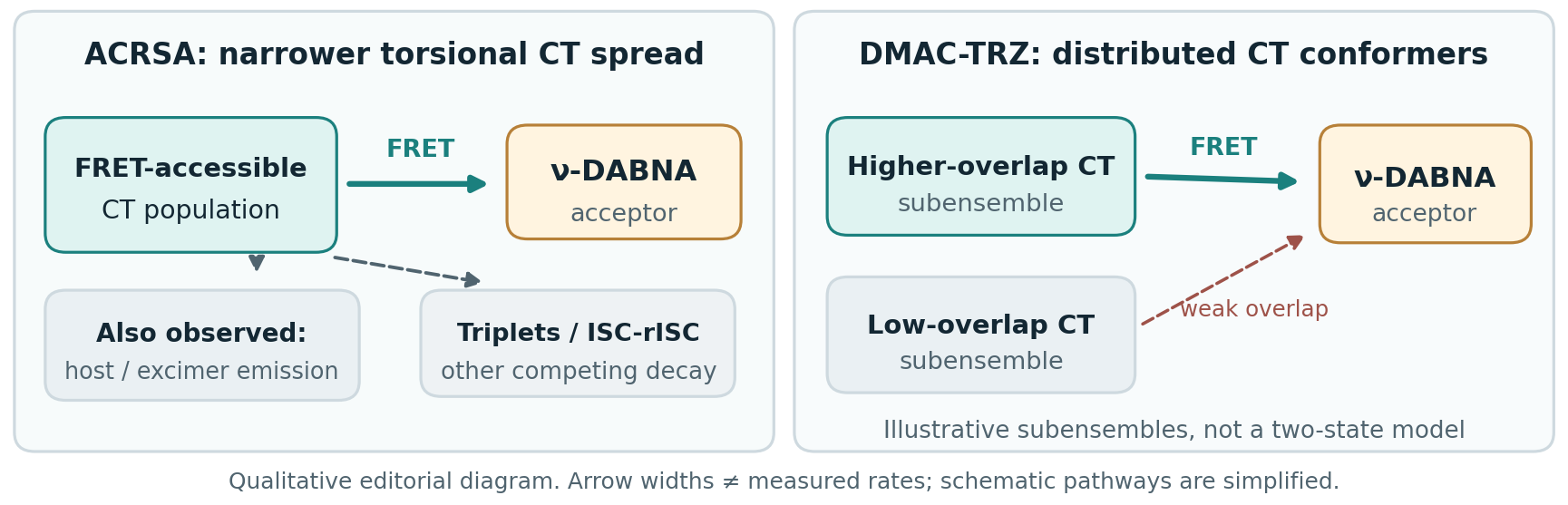
The authors' mechanistic interpretation rests in part on conformational heterogeneity. DMAC-TRZ has populations of donor–acceptor torsional conformers with different CT emission energies and kinetics. Time-resolved spectra reveal contributions from species whose lower-energy emission has little spectral overlap with the ν-DABNA absorption. ACRSA, with a rigid spiro-linked geometry, suppresses the torsion-related low-energy CT conformer distribution in this comparison. This does not imply that the sensitizer-only ACRSA film has only one emissive species: the authors also identify host-related, singlet CT, and excimer contributions. The HF mixture's time-resolved spectra support suppression of the ACRSA excimer channel upon ν-DABNA sensitization, a more specific claim than universal conformational or emissive homogeneity. [1, Figs 1–2; 2, Figs S1–S2]
This matters because a material can have a strong overall PLQY while retaining excited-state populations that are poor donors to the chosen terminal emitter. Conversely, a long donor lifetime can allow a moderately fast transfer process to dominate when competing radiative and non-radiative pathways are slow. The evidence supports this explanation for the studied host, concentrations, sensitizers, and acceptor; it does not prove that rigidity, extended lifetime, or lower intrinsic PLQY independently guarantees better HF performance across other materials.
An apparent energy-ordering puzzle also deserves care. ACRSA's PL maximum is around 500 nm, whereas ν-DABNA's terminal emission maximum is near 476 nm. FRET feasibility cannot be inferred by comparing these two emission peaks. The relevant observable is overlap of the sensitizer's wavelength-dependent emission (including its higher-energy portion and state-specific contributions) with the terminal emitter's absorption; transitions must still satisfy energy conservation. The authors evaluate the spectral overlap integral rather than inferring transfer from peak positions alone. No population-wide uphill energy-transfer pathway should be claimed from these peak wavelengths. [1, spectral/FRET discussion; 2, Fig. S4 and printed p. S2]
The authors treat Dexter exchange transfer as negligible on the basis of estimated mean donor–acceptor separation and its short-range character. However, the separations in Table S6 are inferred from a simplified FRET model, not independently measured structural distances; a mean cannot exclude locally close molecular pairs in a distribution. No independent terminal-triplet-resolved Dexter-rate measurement is supplied. Neglecting Dexter is therefore a working model boundary, not experimental proof of zero transfer. Triplet-sensitive transient absorption, loading dependence, and host-controlled comparisons could test this assumption. [1, FRET analysis; 2, Tables S3 and S6]
4 | Does the film-level argument carry through to devices?
In the device data, the sensitizer ranking changes upon addition of ν-DABNA. Table S7 reports an ACRSA sensitizer-only EQE_max of 11.5%, rising to 28.5% in its HF device. DMAC-TRZ starts substantially higher at 25.0% but decreases slightly to 23.5% in the HF configuration. AZB-TRZ rises from 4.8% to 19.6%; however, its different mCP host and unresolved model-rate discrepancies make it unsuitable as a clean third point on a universal molecule-ranking curve. [1, Fig. 4; 2, Table S7]
| Device series | EQE_max: sensitizer-only → HF | EQE at 1,000 cd m⁻²: sensitizer-only → HF | HF EL FWHM |
|---|---|---|---|
| ACRSA / mCBPCN | 11.5% → 28.5% | 7.7% → 18.6% | 19 nm |
| DMAC-TRZ / mCBPCN | 25.0% → 23.5% | 19.9% → 18.3% | 23 nm |
| AZB-TRZ / mCP | 4.8% → 19.6% | 3.4% → 12.5% | 19 nm |
Source and context: Supplementary Table S7, printed p. S11. EL FWHM is not PL FWHM. The EQE measured at 1,000 cd m⁻² is not EQE_max. This table describes the specific OLED configurations reported in the primary study. [2]
The rise from 11.5% to 28.5% is about a 2.48-fold increase based on Table S7; the article's looser “almost tripled” language refers to the same device trend. Both the numerical improvement and its boundaries should remain visible. Notably, the ACRSA HF device also shows a narrowed EL FWHM of 19 nm, whereas the film's reported PL FWHM is 17.7 nm. These close-looking values belong to different measurement domains and should not be substituted for one another. The concurrence of higher estimated FRET and higher device EQE is supportive but does not isolate FRET as the sole causal mechanism: charge balance, recombination-zone profile, host-mediated capture, transition-dipole orientation, and optical extraction may change between devices. The reported electrical/optical measurements do not independently eliminate all these confounders. [1, Table 1, Fig. 4 and Methods; 2, Table S7]
5 | Device lifetime is a separate test of the mechanism
Higher efficiency does not automatically imply longer OLED lifetime. In the authors' operational tests, the DMAC-TRZ sensitizer-only OLED has an LT50 of 34.0 h, whereas the corresponding HF device reaches 8.5 h, at an initial luminance of 1,500 cd m⁻². For the ACRSA series, lifetime moves in the opposite direction: 28 min to 69 min, at 2,500 cd m⁻². Supplementary Figure S12 visibly corroborates the two within-series trends. [1, Device lifetime; 2, Fig. S12]
These two comparisons should not be collapsed into a ranking of the absolute endurance of ACRSA against DMAC-TRZ: the starting luminances differ, and device architectures and stress conditions matter. Even within a given sensitizer series, matching initial luminance does not prove identical operating current density, exciton generation rate, or chemical stress when device efficiency changes. The lifetime curves in the available SI are plots, not supplied raw time series, and do not establish replicate-to-replicate uncertainties. Supplementary Figure S11 shows successive electrical scans of the same pixel, not a statistical multi-device lifetime study. [2, Figs S11–S12]
A defensible reading is that the proposed efficient energy-transfer pathway coincides with improved lifetime within the ACRSA series, while a less favorable HF pairing coincides with deterioration within DMAC-TRZ. The dataset does not isolate a single molecular cause of the lifetime differences or establish manufacturing-scale reliability.
6 | What the supplementary evidence resolves—and what it does not
The new SI review strengthens the kinetic analysis but does not remove all uncertainties. The FRET-lifetime formula reproduces the reported ACRSA and quasi-equatorial DMAC-TRZ estimates to the displayed precision. Table S6 reports ACRSA η_FRET as 87%, whereas the main article reports 87.8%, which should be cited with its source-specific precision. [1, FRET analysis; 2, Table S6]
The AZB-TRZ modeling requires particular caution, and the discrepancies must remain OPEN until supported by an identifiable correction or author clarification. Table S6 reports k_FRET = 2.46 × 10^7 s⁻¹; Table S5 instead lists 3.75 × 10^7 s⁻¹. The 37% efficiency in S6 can be reconstructed using the 15.05 ns slower prompt component from Table S2, rather than the 11.67 ns mean; that choice is not explicitly justified in the text. In addition, Table S6 labels the AZB host as mCBPCN, whereas Table S2 and the AZB device/film descriptions identify mCP. This apparent host-label discrepancy must not be silently resolved by choosing one entry. These are open primary-source reporting ambiguities, not figures to silently harmonize. [2, Tables S2–S6]
The distance equation on printed SI p. S2 also prints η_FRET at the left despite a right-hand expression with length dimensions. Our audit treats this as a likely notation error, without claiming an author-issued correction. Neither the absolute Förster-radius integrals nor the lifetime fits have been recreated from original raw measurement files. These limitations are reasons to qualify model parameters, not to discard the directly reported spectral and device observations. [2, S2]
7 | The research implication
For molecular screening, this case argues against choosing HF sensitizers solely by standalone TADF EQE, high film PLQY, or a single spectral-overlap metric. More informative candidates should be examined for the distribution of donor conformations, state-resolved emission/absorption overlap, prompt and delayed kinetics, triplet-sensitive loss channels, competing radiative/non-radiative pathways, host and loading dependence, and how the transferred excitations manifest in a fully specified OLED. This is our editorial inference from a limited comparative study, not a universally validated design algorithm.
Three follow-up experiments would particularly strengthen the generality of the claim: (i) matched-host and matched-loading comparisons that separate conformer effects from host/spacing differences; (ii) excitation-resolved and concentration-dependent transfer measurements capable of testing the neglected short-range pathways; and (iii) replicated lifetime tests with a declared drive mode (constant current or constant luminance), starting luminance, contemporaneous current density, stack details, raw traces, and uncertainty reporting. A broader candidate series would be needed before claiming that the proposed screening criterion predicts device performance outside the studied molecules.
Bottom line
Stavrou and colleagues show that the sensitizer that looks best when used as the emitter need not be best when its job is to feed a narrowband terminal emitter. In their reported ACRSA/ν-DABNA devices, film photophysics, kinetic interpretation, increased EQE, and a favorable within-series lifetime change form a coherent body of evidence. DMAC-TRZ provides a revealing counterexample. The result is a compelling, testable strategy for broadening HF sensitizer searches—not proof that low-PLQY TADF molecules are intrinsically superior, that Dexter transfer is absent, or that these devices are already commercially stable.
Sources, methods, and editorial disclosure
[1] Primary article. Stavrou, K.; Franca, L. G.; Danos, A.; Monkman, A. P. Key requirements for ultraefficient sensitization in hyperfluorescence organic light-emitting diodes. Nature Photonics 18, 554–561 (2024). DOI: Primary study DOI. Specific results are traced to the article's Table 1, Figs 1–4, text and Methods.
[2] Author-supplied Supplementary Information. Supplementary Information to [1], printed pages S2–S12, Supplementary Figs S1–S12 and Tables S1–S7 (PDF supplied for this editorial review: 41566_2024_1395_MOESM1_ESM.pdf). Associated with the article DOI above. The SI states that it was provided by the authors and is unedited.
How this insight was prepared. This Research Insight critically synthesizes [1] and [2]. A 64-record primary Source-to-Claim ledger was recovered from the preceding Phase 2B.1 audit and preserved together with 24 linked revision annotations from the v0.2 addendum in a versioned v0.3 register; these do not constitute 88 independent empirical findings. Values are attributed to the authors, not to new measurements by OLED Nexus. We checked selected prompt FRET model arithmetic from the reported fitted lifetimes, but did not independently re-fit raw decays, re-integrate the absolute Förster overlap, resolve conformer populations, or reproduce device lifetime statistics. Source discrepancies, including AZB-TRZ rate and host labeling, remain open and are not harmonized. Figure 1 is an original editorial schematic, not an experimental image or a quantitative kinetic model. Known source discrepancies remain disclosed; any later source corrections or rights notices require editorial follow-up.
Editorial and publication status. The scientific owner accepted this Expert Revised v0.3 Research Insight and authorized public publication on 28 October 2026. It is a source-attributed critical editorial analysis, not new independent experimental research or an article externally peer-reviewed under OLED Nexus auspices. The AZB-TRZ source discrepancies and all stated measurement/model limits remain open; source corrections will be tracked if authoritative updates appear.
← Return to Research Insights · Hyperfluorescence technology guide