The scientific question
Before multiple-resonance thermally activated delayed fluorescence (MR-TADF), blue OLED emitters faced a difficult design tension. A smaller singlet–triplet gap can facilitate thermally activated triplet recovery, but some conventional donor–acceptor architectures employ relatively flexible geometries and charge-transfer states that yield broad emission. Narrow blue spectra can improve color selectivity; any improvement in display throughput or filter losses, however, depends on the optical stack, filters, spectral response, and specified color standard.
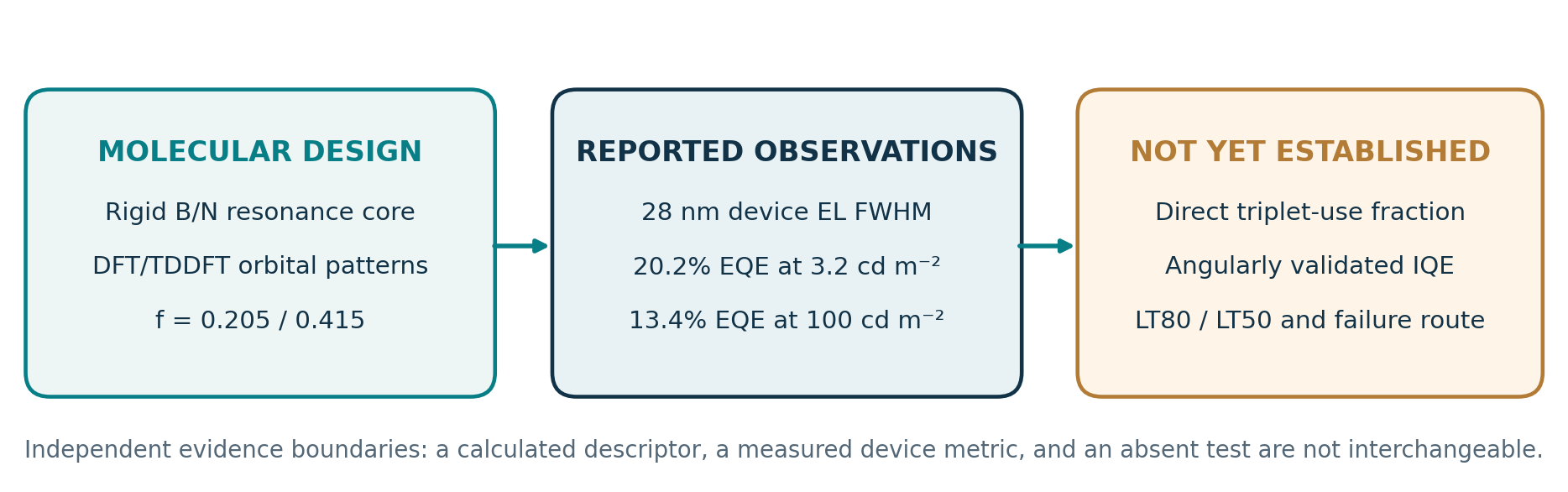
In 2016, Hatakeyama and colleagues reported two B/N-containing MR-TADF molecules, DABNA-1 and DABNA-2, which combined rigid conjugated cores with narrow blue electroluminescence (EL). The DABNA-2 OLED exhibited 28 nm EL full width at half maximum (FWHM) and 20.2% peak external quantum efficiency (EQE), measured at only 3.2 cd m⁻². These results established an important proof of molecular and device concept, not sustained high-brightness performance or operational lifetime. [1, pp. 2777–2781]
The useful question is what the first study measured, what its electronic-structure and kinetic models inferred, and what was not tested. This distinction is the organizing principle of the present assessment.
1. Multiple-resonance orbital design is not a complete excited-state measurement
The design exploits electronically different contributions from boron and nitrogen in a common fused aromatic framework. The authors' B3LYP/6-31G(d) HOMO/LUMO plots show a site-alternating orbital-amplitude pattern. Unlike typical twisted donor–acceptor arrangements, this provides a route to reducing aspects of electron–hole overlap while retaining a comparatively rigid molecular scaffold. [1, Figs. 1–2]
The calculated S₀→S₁ oscillator strengths were 0.2047 for DABNA-1 and 0.4149 for DABNA-2. Peripheral substitution in DABNA-2 changed transition strength without requiring a freely rotating donor–acceptor junction. These are calculated, method-dependent descriptors (TDDFT at the stated level), not directly measured photon-emission rates. [1, Fig. 2; 2, Table S1, printed S-7]
Likewise, orbital pictures should not be treated as complete maps of the excitation's transition density. A fuller contemporary analysis might compare natural transition orbitals, electron–hole attachment/detachment densities and vibronic reorganization. Those additional analyses are recommendations, not measurements reported by the 2016 authors. The original work nonetheless demonstrated that rigid multiple-resonance design could combine narrow blue spectra with delayed-fluorescence photophysics.
2. Keep solution PL, film PL and complete-device EL separate
The original study reports spectra and yields in different measurement environments. These are not interchangeable.
| Measurement and environment | DABNA-1 | DABNA-2 |
|---|---|---|
| Solution PL peak; CH₂Cl₂, 298 K | 462 nm | 470 nm |
| Solution PL FWHM; CH₂Cl₂ | 33 nm | 34 nm |
| Solution PL quantum yield | 0.89 | 0.85 |
| Film PL peak; 1 wt% in mCBP | 460 nm | 469 nm |
| Film PL FWHM; 1 wt% in mCBP | 30 nm | 28 nm |
| Film PL quantum yield | 0.88 | 0.90 |
| OLED EL peak; 1 wt% device | 459 nm | 467 nm |
| OLED EL FWHM; 1 wt% device | 28 nm | 28 nm |
| OLED CIE (x, y) | (0.13, 0.09) | (0.12, 0.13) |
Low-temperature fluorescence/phosphorescence spectra yielded singlet–triplet splitting estimates of 0.14–0.18 eV across the two compounds, while a separate kinetic treatment produced approximately 0.20 eV for both. These are operational estimates derived from different assumptions and procedures. They must not be pooled as if they were identical vertical excitation energies, nor does either value uniquely determine the microscopic RISC pathway. [1, Tables 1–2; 2, printed S-18–S-19]
An EL FWHM of 28 nm is an important demonstration of a narrow spectral band. It does not, by itself, prove a particular CIE standard is satisfied in a display, eliminate filter losses, or establish voltage-, angle- and aging-invariant color. A fair comparison reports the spectrum type and the measurement conditions.
3. Delayed fluorescence supports triplet involvement, not a unique device-level harvesting efficiency
The doped films showed prompt fluorescence and a delayed emission component whose temperature dependence was consistent with TADF under the authors' analysis. The reported rate parameters were inferred from transient PL and separated yield components with an adapted kinetic model; they were not independently measured elementary spin-conversion rates. [1, Table 2; 2, Figs. S10–S12]
| Film observable or inferred property (1 wt% mCBP, 300 K) | DABNA-1 | DABNA-2 |
|---|---|---|
| Total measured PL quantum yield, Φ | 0.880 | 0.897 |
| Prompt yield component, ΦF | 0.845 | 0.843 |
| Delayed yield component, ΦTADF | 0.035 | 0.054 |
| Prompt PL lifetime, τF | 8.8 ns | 6.0 ns |
| Delayed PL lifetime, τTADF | 93.7 μs | 65.3 μs |
| Model-estimated kF | 9.6 × 10⁷ s⁻¹ | 14.1 × 10⁷ s⁻¹ |
| Model-estimated kRISC | 9.9 × 10³ s⁻¹ | 14.8 × 10³ s⁻¹ |
| Model-estimated ΔEST | 0.20 eV | 0.20 eV |
A crucial excitation-boundary distinction: under optical excitation, an initial singlet population is prepared and its subsequent prompt/delayed emission is measured. Electrical operation can generate singlet- and triplet-containing populations through additional recombination and transfer pathways. Therefore ΦTADF = 0.035 or 0.054 is not the fraction of electrically generated triplets harvested in an OLED, and it cannot independently validate or refute near-unity internal EL efficiency. Conversely, the observation of delayed PL does not quantify a unique triplet-to-photon conversion probability during electrical operation.
The model-derived kRISC for DABNA-2 exceeds that for DABNA-1, but the study also reports differences in oscillator strength, prompt decay and other properties. It is inappropriate to assign the entire device-EQE improvement to a single rate constant. The observed delayed lifetime is a coupled kinetic outcome; in general, 1/τTADF is not equal to elementary kRISC.
Source-internal discrepancy in the official SI (still OPEN)
For DABNA-1, SI printed S-18, Eq. (5) lists ΦF = 0.845, ΦIC = 0.115, and ΦISC = 0.397. Yet the stated equation gives 1 − 0.845 − 0.115 = 0.040, and the author's listed rate constants give approximately 0.0397. Substituting this latter value into their Eq. (6) reproduces kTADF close to 9.39 × 10³ s⁻¹; substituting the printed 0.397 produces a tenfold lower result. [2, printed S-18]
This is strong evidence of an internal decimal-place inconsistency in the printed intermediate, not an official correction issued by the authors or publisher. The downstream model should not be declared entirely invalid on this basis, but the printed ΦISC = 0.397 must not be silently converted into a verified value. In this revision the discrepancy remains OPEN, pending formal clarification.
4. The EQE record was obtained at low luminance
The authors' nominal multilayer OLED structure was ITO (50 nm) / NPD (40 nm) / TCTA (15 nm) / mCP (15 nm) / mCBP:DABNA (20 nm) / TSPO1 (40 nm) / LiF (1 nm) / Al (100 nm). The 1 and 5 wt% comparisons refer to emitter concentration in the mCBP layer, not to the whole stack. The device EQE evaluation assumed a perfect diffuse (Lambertian-like) emitting surface, and the SI does not provide an independent angular/goniometric validation of that assumption. [1, p. 2779; 2, printed S-21]
| Device | Peak EQE and luminance | EQE at 100 cd m⁻² | EL peak / chromaticity |
|---|---|---|---|
| DABNA-1; 1 wt% | 13.5% at 0.6 cd m⁻² | Not stated in the main-text prose | 459 nm; 28 nm FWHM; (0.13, 0.09) |
| DABNA-2; 1 wt% | 20.2% at 3.2 cd m⁻² | 13.4% | 467 nm; 28 nm FWHM; (0.12, 0.13) |
| DABNA-2; 5 wt% | 20.0% at 4.1 cd m⁻² | 14.8% | 471 nm; CIE (0.12, 0.17) |
For DABNA-2 at 1 wt%, EQE falls from 20.2% at 3.2 cd m⁻² to 13.4% at 100 cd m⁻², a 6.8 percentage-point decrease, or approximately 33.7% relative to the peak value. This is a comparison of two published points, not a complete roll-off mechanism determination. At 5 wt%, EQE at 100 cd m⁻² increases to 14.8%, while the emission shifts from 467 to 471 nm and CIE y changes from 0.13 to 0.17. The source associates this redshift with concentration quenching; a uniquely isolated microscopic cause was not demonstrated by that comparison alone. [1, footnote 27]
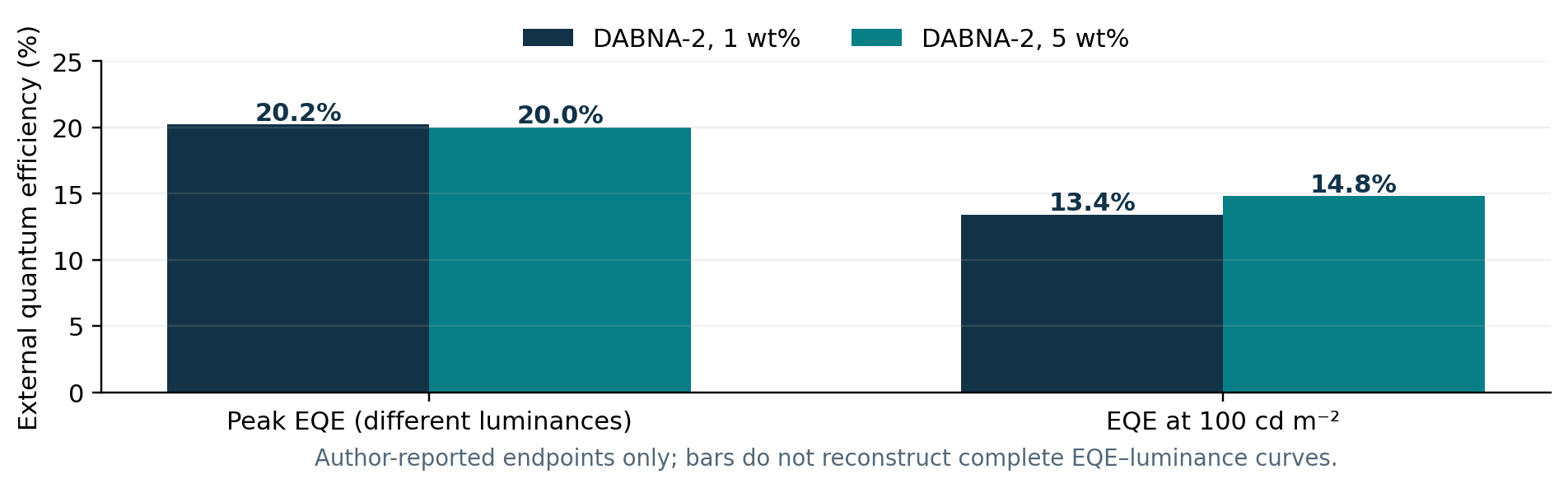
The authors explicitly state that their devices did not reach 1,000 cd m⁻² maximum luminance and displayed pronounced efficiency roll-off. Limited spin up-conversion, charge imbalance, triplet–triplet annihilation and exciton–polaron quenching are possible explanations, not individually established by controlled in-device mechanistic isolation. The observations therefore do not demonstrate practical high-brightness performance. [1, p. 2780]
5. Near-unity IQE was inferred, not directly measured
The reported approximately 100% internal quantum efficiency (IQE) was obtained by dividing peak EQE by an assumed 20% optical outcoupling efficiency. The arithmetic 20.2% / 0.20 ≈ 101% slightly exceeds the physical ceiling, underscoring the approximate nature of the assumed extraction fraction and experimental uncertainty; it is not evidence of a real IQE above 100%. [1, p. 2780]
This inference additionally requires care in separating useful charge recombination, internal photon generation and external light extraction. Film PLQY ≈ 0.90 measures an optically excited specimen, not device IQE; the delayed PL fraction does not directly supply an electrical triplet-use fraction. No comprehensive, independent angular outcoupling characterization or direct device-wide triplet-harvesting measurement is supplied in the examined 2016 main article/SI. An appropriate historical statement is “peak EQE 20.2%; near-unity IQE estimated assuming 20% outcoupling.”
6. Stability and manufacturability were not established
The 2016 paper and associated SI report syntheses, spectral analysis, transient PL and current–voltage–luminance / EQE behavior. They do not report operational LT80/LT50, device-aging failure distributions, replicate lifetime statistics or chemically identified electrically aged degradation products. This absence is not evidence that the materials were unstable; it means a numerical operational lifetime cannot be extracted from the sources. [1,2]
Likewise, the reported 6.00 g syntheses, purification and HPLC purity values establish certain synthesis and characterization outcomes, not commercial-scale yield, roll-to-roll compatibility or long-lived production pixels. Device encapsulation and low-brightness efficiency do not replace a controlled aging protocol. Excited-state lifetimes measured in nanoseconds or microseconds must not be confused with electrical operating lifetimes measured over hours.
7. What an informative successor experiment would test
A useful follow-up would preserve the original narrowband design insight and test at least four independent boundaries:
- Spectral/optical: obtain calibrated angle-resolved EL and an optical-stack model; report EL FWHM and chromaticity at defined luminances and over viewing angle.
- Device brightness: measure EQE at prespecified application-relevant luminance and current density, include charge-selective controls, and separate recombination-zone effects from RISC hypotheses.
- Kinetics and concentration: acquire temperature/fluence-dependent transient PL and triplet-sensitive measurements over host/doping series, jointly fit alternative kinetic models and report parameter identifiability.
- Electrical stability: measure LT80/LT50 at defined initial luminance and drive protocol with replicate pixels, matched stacks, optical drift checks and, where feasible, chemical analysis after electrical aging.
An informative dataset would state which observations are measured, which quantities are model-estimated, and which proposed degradation or transfer channels remain hypotheses. Independent validation is needed before transferring mechanistic conclusions between films and multilayer OLEDs.
Conclusion and editorial gate
The first DABNA OLEDs were a genuine MR-TADF landmark: rigid resonance-localized molecular design, narrow 28 nm blue EL, and a 20.2% peak EQE were demonstrated together. Their efficiency maximum, however, occurred at very low luminance, high-brightness EQE deteriorated, IQE required an assumed extraction factor, and no quantitative electrical operating lifetime was reported. The official SI also contains an unresolved ΦISC intermediate inconsistency that should be transparently disclosed rather than silently corrected. [1,2]
The study established a compelling molecular design route; it did not resolve all of the optical, exciton-loss and degradation challenges of practical blue OLEDs. Scientific owner approved the independently reviewed scientific revision v0.2 for OLED Nexus publication on 29 October 2026. This article is not an original experimental study or a publisher correction; website production deployment and public acceptance require separate verification.
Primary references and source access
[1] Hatakeyama, T.; Shiren, K.; Nakajima, K.; Nomura, S.; Nakatsuka, S.; Kinoshita, K.; Ni, J.; Ono, Y.; Ikuta, T. “Ultrapure Blue Thermally Activated Delayed Fluorescence Molecules: Efficient HOMO–LUMO Separation by the Multiple Resonance Effect.” Advanced Materials 28, 2777–2781 (2016). DOI: https://doi.org/10.1002/adma.201505491. Full published main paper referenced by the original evidence ledger and checked against the publisher record.
[2] Official associated Supporting Information, adma201505491-sup-0001-S1.pdf, 30 PDF pages, printed S-1–S-29. The kinetics at printed S-18–S-19, device methods at S-21, and spectra/efficiency figures are cited at source level. The SI's printed ΦISC value remains unresolved.
Editorial note: Original diagrams in this revision are newly drawn explanatory graphics, not copies of published figures. Original published data remain attributed to [1]/[2]. The 25-entry full source-to-claim register from the input package is retained and a separate revision addendum records new qualifications.